Will Islam become the world’s largest religion?
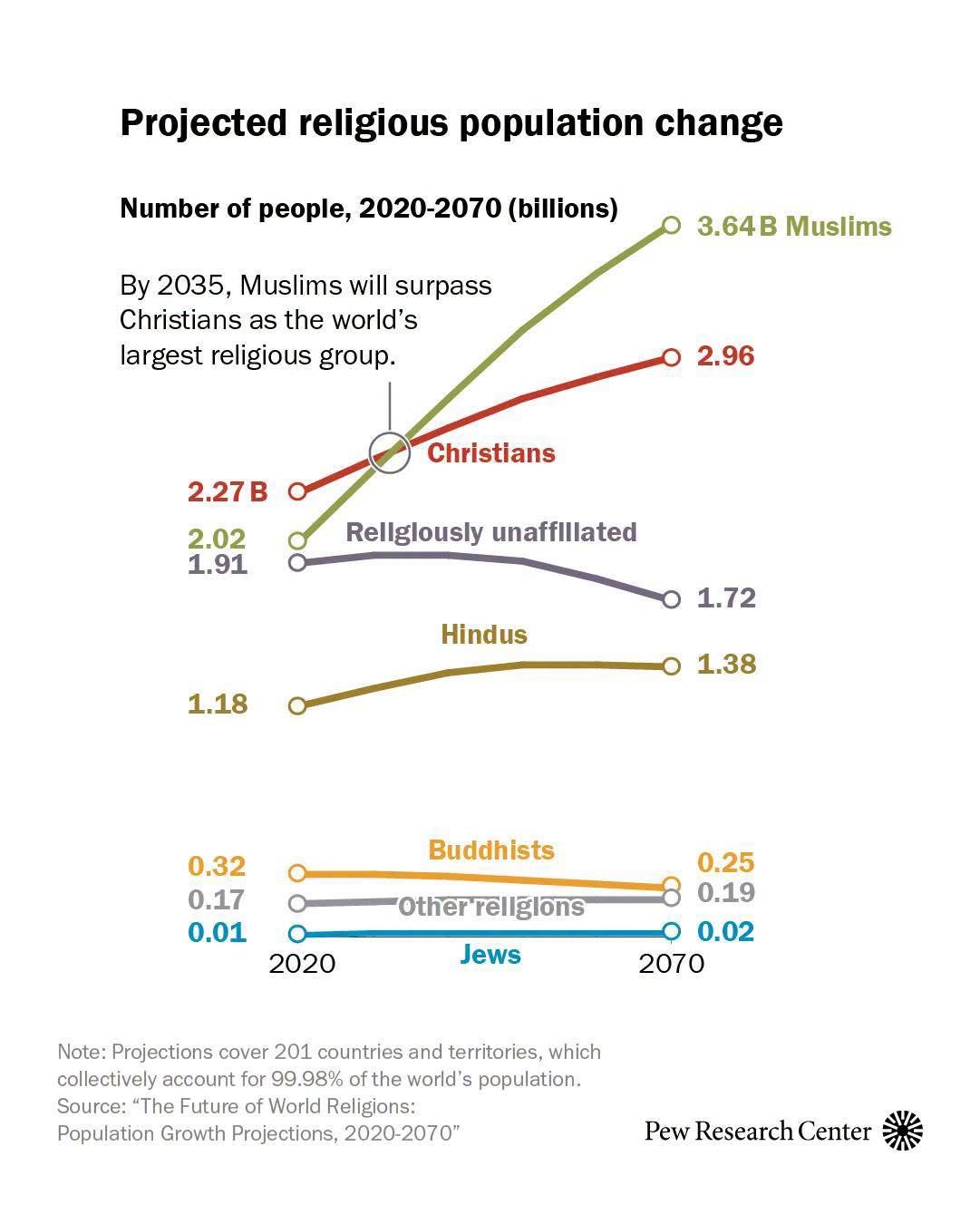
Islam will become the world’s largest religion by 2035, according to Pew. However, the study’s findings and methodology are seriously flawed, argues Khaled Diab, author of The Alternative Guide to Islam, in this video.
Islam is the fastest growing major religion and will supposedly overtake Christianity to become the world’s largest faith community by 2035, according to a Pew’s forecast.
This news has had some conservative Muslims figuratively popping the proverbial champagne to celebrate their faith’s apparent superiority to its main rival.
In contrast, many conservative Christians met the news with reactions clothed in the figurative black garb of mourning and panic about the apparent Islamisation of the world, including the West.

But are these reactions justified?
In truth, this flawed study tells us very little about the state or health of the world’s religions.
Although both Christianity and Islam are set to grow, Islam will grow faster simply because Muslims are projected to have more babies than Christians. This reveals almost nothing about the relative appeal of either faith, as conversions play a negligible role in the growth of either.
In fact, Pew forecasts that more people will convert away from the two top religions than convert into them.
This study also does not tell us how many people actually believe in and practise their birth faiths and how many only loosely belong to their religion through familial affiliation or culture.
This not only applies to “ethnic religions” like Hinduism and Judaism, but also to universal religions like Islam and Christianity.
This treatment of Islam and Christianity as de facto ethnic religions manifests itself in, for instance, how Pew defines minors and as yet unborn children as belonging to their heritage religion. So much for freedom of religion.
In addition, the study relies heavily on census data but censuses are radically flawed. Even in the freest countries, they may not provide an accurate picture because not everyone will admit to strangers what their actual belief system is or many people associate culturally with their hereditary religion.
In (ultra-)conservative countries, where conversion or unbelief carry serious consequences, people may be terrified to answer the census or even telephone surveys honestly.
Iran, for example, is 99.8% Muslim, according to Pew. However, given the theocracy’s repressive restrictions on freedom of religion and conscience, this is likely a massive distortion. It is highly unconvincing that Christians, Jews, Zoroastrians, atheists and the irreligious only make up 0.2% of Iran’s population. The World Values Survey puts the proportion of atheists in Iran at over 1%, which is itself likely an underestimation based on anecdotal evidence.
This Pew study appears to drastically underestimate the number of unbelievers in two ways. By underestimating the number of unbelievers living today and by assuming today’s minors and children born in the future will mostly follow their parents’ presumed faith.
So, when reading (about) this study, please take it with a massive pinch of salt.