Russia takes a “grown up” beating

 
VN:F [1.9.22_1171]
Rating: +3 (from 3 votes)
VN:F [1.9.22_1171]
Rating: 10.0/10 (3 votes cast)

By Ray O’Reilly

The acid attack on the Bolshoi ballet’s director highlights the worrying spread of crime, corruption and intimidation to all facets of life in Russia. Update: reports coming out indicate that long-running internal strife at the Bolshoi may be connected to this attack.

Wednesday 30 January 2013 [update 19 Feb 2013]

Is no one safe from Russia’s criminal gangs and shady types? Kidnappings, extortion, bribes, threats … a litany of evil stuff that ordinary Russians face on a daily basis. Now the acid attack on Bolshoi ballet’s Sergei Filin puts Russia’s revered cultural institution in the spotlight.

Cut someone off on the road, fall foul of the police, forget to pay ‘taxes’, start up a rival business … or just become a public figure and you could well find yourself on the wrong side of a dangerous character.

What are the police doing about it? On paper, what the police are supposed to do: investigate, report and occasionally charge someone with a crime. But ask a Russian what the police are doing and the answer will inevitably be “very little” or “too much”.

It’s probably this kind of cryptic logic that got Russia into the trouble it now faces. Corruption, it seems, cuts deep into everyday life in Russia. I entered a search query starting with “Why are Russians …” and Google’s auto-complete function offered “so crazy and ruthless” before I had even finished writing “Russia”. The query results were illuminating. The top spot went to a Yahoo question-answer which elaborated on the Russian mafia’s turf battle with Italian-Irish hard-men in New York.

I then drifted to a story by Business Insider on why Russians use car dashboard cams to record “crazy” stuff on the road, from police graft and road rage to hit-and-runs. There is even a YouTube montage of some of the footage gathered by these ‘dash-cams’.

Russia’s former president Dmitry Medvedev blamed these problems on the “undisciplined, criminally careless behaviour of our drivers”, along with poor road conditions. The police also come in for criticism in the Business Insider report. According to Transparency International’s Corruption Perceptions Index, corruption undermines countries and institutions and “generates popular anger that threatens to further destabilise societies and exacerbate violent conflicts”.

Indeed, it is the sort of violence we are now witnessing as it spreads from business and politics into the cultural and arts scene in Russia – a facet of life you would not ordinarily expect to be dragged into the greed and graft cycle. In 2012, Russia ranked 133rd on the corruption index. “While no country has a perfect score, two-thirds of countries score below 50, indicating a serious corruption problem,” notes Transparency International.

According to the Organised Crime and Corruption Reporting Project (OCCRP), a Russian initiative, a big chunk of that corruption is by traffic police, which along with kindergartens and universities, was ranked by Russians as the country’s most corrupt institution. “Over half of the population surveyed who interacted with traffic police said that they had been asked for a bribe,” the OCCRP reported.

Transparency International sums up the trickle-down damage that corruption inflicts on a society where trust in eroded: “Corruption translates into human suffering, with poor families being extorted for bribes to see doctors or to get access to clean drinking water. It leads to failure in the delivery of basic services like education or health care. It derails the building of essential infrastructure, as corrupt leaders skim funds. Corruption amounts to a dirty tax, and the poor and most vulnerable are its primary victims.”

This sort of corrupt influence doesn’t seem to stop at Russia’s borders. Interpol must have proverbial drawers-fall of mug shots of organised crime gangs operating out of Russia. Rumour has it that the Russian mob is establishing a foothold in underworlds in major cities around the world, from New York to Antwerp. (Clearly, I didn’t ask Interpol or the gangs to confirm this!)

Culture of violence?
Read any webpage on Russian culture and you will be reminded of its rich history, strong traditions and influential arts, especially literature, classical music, architecture and of course the ballet. People like Sergei Filin, head of Russia’s Bolshoi ballet, are household names in Russia … hell, the whole world. In fact, he is not the first ‘cultural name’ to come to the underworld’s attention.

“[Filin’s] acid attack has laid bare the poisonous atmosphere that has gripped the Bolshoi,” reports The Guardian. “Once the pinnacle of Russian cultural achievement, the theatre has been beset by scandal in recent years. Even a much-vaunted reopening in October 2011 was marred by accusations of corruption and poor workmanship.”

The attack puts the spotlight on a wave of violence that has swept Russia’s arts scene. In the past weeks, several theatrical figures connected to theatres in St Petersburg and Moscow were reported to have been threatened or beaten up.

Kirill Serebrennikov, a director at the Gogol theatre in Moscow, went so far as to publish on his Facebook page the threat he received, which according to The Guardian story went as follows: “Malobrodsky probably didn’t tell you what we said while we were beaten [sic] his Jewish mug, but if you don’t leave the Gogol theatre then you will be next. Happy New Year, with new feelings. They’ll beat you in a grown-up way. Wait for it.”

With all this crime, intimidation and fear of everything from shake-downs to death threats, it is little wonder that Russians record their trip to the supermarket on their dash-cam. But the scariest thing about this Filin story – and the thing that inspired me to write this little missive was the odd phrase, “They’ll beat you in a grown-up way”. It says your life, our lives, are filled with child-like notions of fair play. Where a dispute ends in a push-fight or a shouting match and everyone makes friends after the teacher intercedes.

In this dark underbelly, there is no teacher to protect you and the push could be at the end of a shank. A juxtaposition of innocence against anarchy… with all the makings of a Russian realist novel!

[Stay tuned for more intrigue!]

VN:F [1.9.22_1171]
Rating: 10.0/10 (3 votes cast)
VN:F [1.9.22_1171]
Rating: +3 (from 3 votes)
Tags: , , , , , , , , , , , , , ,

Related posts

A careless killer on the loose…

 
VN:F [1.9.22_1171]
Rating: 0 (from 0 votes)
VN:F [1.9.22_1171]
Rating: 0.0/10 (0 votes cast)

By Khaled Diab

Gun and knife violence gets a lot of public attention but one killer prowling our streets goes largely unnoticed… apathy.

Thursday 24 January 2013

It was a case of senseless violence followed by a needless death. Peter Vercauteren, a 43-year-old Belgian artist and local community leader, was heading home late one night in the heart of Sint-Niklaas, not far from the picturesque market square, the largest in the country, for which this smallish town is best known.

Vercauteren, “Pee” to his friends, was followed by another punter with whom he’d allegedly had a bit of a shouting match in the pub, even though, by all accounts Vercauteren was a jovial man with a big heart and a booming laugh that could be heard long before its owner could be seen.

His assailant, Wesley L, head-butted Vercauteren so hard that he collapsed on a dark street and died… eventually.

Had this been the whole story then this tragedy would have remained a largely private one. But what happened next has had locals, who went on a silent march to express their outrage at his preventable death, searching for explanations.

While Vercauteren lay dying outside a kebab shop, under the apparently unwatchful eye of a police surveillance camera, a number of people walked past him without stopping to offer assistance, including his attacker who returned for a second look. An hour and a half later, someone finally put in a call to the emergency services, by which time it was too late.

This carries echoes of a similar tragedy, in 2006, when Joe Van Holsbeeck, 17, was not only stabbed for his mp3 player on a busy rush-hour train platform in Brussels, but no one came to his aid.

One explanation for why no one lifted a finger to assist Vercauteren, as one friend, Steven, put it to me, is that passers-by may have assumed he was just a drunk who had fallen into a booze-induced stupor.

While this could well be what (de)motivated some from rushing to the fallen man’s aid, I find this diagnoses the symptom more than the underlying condition. Even if Vercauteren was a passed-out drunk, surely this, in a cordial, educated society whose sense of solidarity is reflected in its high tax rates would prod people to act, despite knee-jerk snobbery towards “tramps”. After all, in addition to the danger of choking on vomit, an unconscious drunk also runs the risk in winter of developing hypothermia or freezing to death.

Another, more convincing reason is simple, instinctive, gut-wrenching fear. “The uncertainty in society has increased the level of fear, and this undoubtedly played a role,” says Roel Thierens (23), who volunteered in a youth centre, Kompas, where Vercauteren also worked.

And, indeed, though much of Europe is perhaps the safest it has ever been, a neurotic media and fear-mongering politicians induce in many people a sense of disproportionate fear and distrust of, not to mention alienation from, others, especially immigrants and minorities. But fear, especially in a situation as unthreatening as this, can be overcome.

At heart, what this could all boil down to is that the true accomplice in this crime was apathy and indifference. “Passers-by might well have thought that somebody else is bound to help him,” notes Wouter Thierens (26), Roel’s brother who also volunteers at Kompas.

Many social conservatives see such apparent apathy as a sign of the breakdown in traditions and family values. But what this overlooks is that, though families have become less central than they once were, they still play a pivotal and central role in the lives of most Belgians.

Additionally, in countries where family is still paramount and traditional community remains important, such wilfull blindness also occurs, as demonstrated by the recent outrage when passengers reportedly stood by as a young woman was gang raped and beaten to within an inch of her life on a Delhi bus. And similar incidents occur in the Middle East.

Moreover, in a modern, well-oiled, mechanical society, like that which is prevalent in northern Europe, it is not that people have abandoned their sense of community and solidarity, though some erosion has occurred thanks to the greater individual alienation witnessed in contemporary society, but that it has changed to become more impersonal and distant. Citizens, aka taxpayers, have grown to expect the ‘system’ to take care of everything and everyone: the destitute and the desperate, the weak and the sick, and the criminal and their victims.

However, important as such systemic solutions are, we still need a certain sense of personal social responsibility.

___

Follow Khaled Diab on Twitter.

This article first appeared in The National on 21 January 2013.


VN:F [1.9.22_1171]
Rating: 0.0/10 (0 votes cast)
VN:F [1.9.22_1171]
Rating: 0 (from 0 votes)
Tags: , , , , , , , , , , , , , , , ,

Related posts

The Mubarak regime’s legalised robbery

 
VN:F [1.9.22_1171]
Rating: 0 (from 0 votes)
VN:F [1.9.22_1171]
Rating: 0.0/10 (0 votes cast)

By Osama Diab

Since the ‘Mubarak mafia’ were not outlaws but were the law, proving that Egypt’s lost billions were ill-gotten is an elusively difficult challenge.

Monday 17 September 2012

“Tell us Mubarak, how could a pilot make 70 billion?” protesters chanted during the 18-day revolution which ousted former Egyptian President Hosni Mubarak in February of last year. The chant was a reaction to reports that Mubarak’s family fortune could be as high as $70 billion.

I was part of a BBC investigation team that was formed to reveal unexposed facts about “Egypt’s Stolen Billions”. The team produced a documentary on unfrozen assets in the UK related to the Mubarak regime which was aired recently on BBC Arabic.

You need to a flashplayer enabled browser to view this YouTube video

Decades of authoritarian corruption helped Mubarak and his family and friends accumulate tens of billions of pounds, leaving millions of Egyptians living in dire poverty. It is impossible to measure accurately the economic cost of Mubarak’s rule, but figures from the World Bank suggest that $134.4 billion (817 billion Egyptian pounds) worth  of public assets went missing over the past 30 years.

So far Switzerland has frozen $800 million and the the UK about $120 million in assets related to the Mubarak regime, but Egypt hasn’t yet seen a penny of it returned. To do so, Egypt must prove that the money was “ill-gotten” first.

“It is crucial that the recovery and return of stolen assets is lawful,” Alistair Burt, UK Minister for the Middle East and North Africa, said in an official statement published on the website of the British embassy in Cairo last week. “It is simply not possible for the UK to deprive a person of their assets and return them to an overseas country in the absence of a criminal conviction and confiscation order.”

However, this statement, even though it sounds reasonable, ignores the legal challenges involved in proving the wrongdoings of the Mubarak regime.

To identify the truth amid the many rumours surrounding this sensational issue, it was necessary for the team to find solid and documented evidence of the systematic impoverishment of Egypt at the hands of its former rulers, who received the official status of being a network of organised crime from the Swiss government in May, as the BBC team has discovered.

During my quest in Cairo, I sipped tea and ate liver sandwiches on street cafes with dissident government officials. We spoke to economists, lawyers, activists, members of parliament and bankers over more than six months. Their reactions to our investigation ranged from daily calls to offer assistance to suspicion I was a spy working for the Mubaraks.

They were all trying relentlessly to expose facts about the Mubarak regime’s corruption. The problem is that they were trying to prove it according to existing laws which were put in place by the Mubarak institutions.

The parliament – which is responsible for drafting and passing legislation – was completely dominated by Mubarak’s National Democratic Party through vote-buying, rigging and political intimidation.The cabinet was also dominated by businessmen belonging to the ruling party. Since 2004, the Council of Ministers was unofficially known as the “businessmen’s cabinet”.

Reda Eissa, an independent economic researcher, shows through his research how certain companies benefited from tax laws and breaks introduced by these institutions for their own benefit. Companies owned by figures close to the regime ended up paying almost no to very little taxes. The Six of October Development and Investment Company (SODIC), a real-estate giant by Mubarak’s in-law Magdy Rasekh, was paying about 0.5% in tax, according to Eissa’s study.

I found out from my sources that in Mubarak’s Egypt, the laws allowed some banks, such as the Arab International Bank (AIB), to escape the monitoring of the Central Bank of Egypt (CBE) or any other local authority. This meant that some Egyptian banks could transfer any sums of ill-gotten gains without the knowledge of the CBE. The transactions simply did not appear on any records accessible to the authorities as stated by the law.

The founding charter of the AIB, which was established as a joint project in 1974 between the governments of Egypt, Libya, Qatar, Oman and the United Arab Emirates, states that the bank falls outside the authority of local governments and is therefore exempt from taxation, exchange controls and the CBE’s auditing regulations.

The bank was the subject of many allegations for being a channel for suspicious money transfers before, during and after the revolution. More than a year after the revolution, the bank finally responded by stating on its website that it falls under the jurisdiction and supervision of the Central Bank.

The team was also able to meet many dissident bureaucrats who have gathered hundreds of documents and are still struggling with them in the Egyptian courts. These dissident bureaucrats provided the BBC with proof of another “legal” practice which allowed for the exploitation of the country’s wealth. The government, namely the ministries of tourism and housing, had the legal authority to allocate land by  direct order at prices they decided to whomever they chose without recourse to any proper tendering process.

The bureaucrats gave us evidence that in many cases the land was gravely undervalued and given to either Mubarak’s in-laws or close friends. The documents, of which some are official government reports, show that due to this undervaluation Egypt has lost tens, if not hundreds, of billions of pounds in revenues – even though the practice was perfectly “legal”.

“We talk about $200 billion that were stolen illegally, but if you discuss the lawful mechanism that was unethical, we are talking about a trillion dollars,” says Mohamed Mahsoub, the current Minister of Legal Affairs in the recently-appointed cabinet.

When a mafia-like group ‘owns’ a state with its legislative, judicial and executive powers, corruption no longer becomes illegal. This ‘organised crime’ network, fostered by the family of Egypt’s ousted dictator, was not operating outside the law, because they were the law – in fact, they were everything.

Laws were simply drafted by them for their benefit. Law enforcement institutions were also their own private property. Accordingly, any effort to prove the Mubarak regime money was ill-gotten should not focus on whether they brok laws of their own making. What is acquired on illegitimate grounds should, by extension, also be illegal. The focus instead should be on the much easier task of proving the regime was an unelected dictatorship which benefited financially from being in power, even if on paper, it was all “legal”.

Follow Osama Diab on Twitter

VN:F [1.9.22_1171]
Rating: 0.0/10 (0 votes cast)
VN:F [1.9.22_1171]
Rating: 0 (from 0 votes)
Tags: , , , , , , , , , , , , , , , , , , , , ,

Related posts

Detained Egyptian musician vows: “I will not be silenced” about police brutality

 
432063_10150546002709290_513824289_9183732_1059262147_n
VN:F [1.9.22_1171]
Rating: +2 (from 2 votes)
VN:F [1.9.22_1171]
Rating: 9.3/10 (3 votes cast)

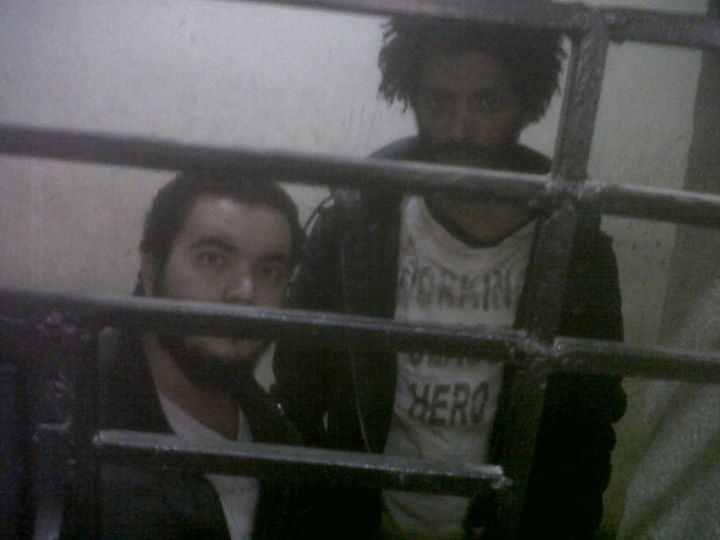
Mohammed Jamal, the lead singer of the popular Egyptian indie band Salalem, tells The Chronikler his story about a night of hell in police custody.

Sunday 12 February 2012


I thought it over carefully before deciding to write about this humiliating incident – an incident that has no rhyme or reason to it, but reflects the reality that the police force still needs to be completely cleansed of the corrupt Mubarak-era officers who still think they are free to hurt the dignity of anyone they simply don’t like. My friend and band mate Walkman and I were victims of these immoral cops.

We were heading home one night after our concert at the Cairo Jazz Club, where we had performed with the Canadian singer NEeMA, when we approached an ordinary police checkpoint. The police signalled for us to pull over and politely asked to see my driving licence and our identification cards – which we handed over, also politely. They then asked to search the car and search us and, out of politeness, we let them. After they were done and had not found anything illegal or suspicious on us, they allowed us to continue on our way, and we did.

Shortly after I drove off, I realised that I hadn’t taken back my ID card from the police officer who had searched us. Just to be certain, we searched the car first for the card, and when we couldn’t find it, we decided to return to retrieve it.

Back at the checkpoint, we tried to find the policemen who had searched the car (it was busy and there were a lot of cars being checked over). When I found the officer in question, he insisted that he had given it back to me and then asked me to park because I was blocking the traffic and that he would come and search the car with me for it. Meanwhile, Walkman had wandered off to ask other if they have seen my ID. As I was searching the car with the officer, Walkman innocently asked another policeman about my ID, which he somehow took personally as an accusation of theft and proceeded, with a gang of other coppersm to kick and punch Walkman. When I came to Walkman’s aid, the police turned mercilessly on me too.

Our attempts to arrest the blows flying at us were futile. After a long session of beatings, we were dragged to a waiting police car. They confiscated my car and our phones. On the way to the police station, a police officer handed me my ID and told me, “Here you go, your card”. When we reached the station, we were already in complete shock and awe from what had just happened to us – something we had never experienced before. They walked us to a room in which there was a miserable, low-ranking officer from the remnants of the former regime. No one touched us in the police station but they were very generous with the swearing and insults.

By this stage, we were already so depressed and humiliated that the names they were calling us had no affect. We were also accompanied by a large number of serious criminals, many of whom seemed to be friends with the cops and they all had a laugh together.

The officer then approached us and said, “Fuck the revolution that made you think you could mistreat police officers. Why the fuck am I being drained on the streets all day. Isn’t it for you? What a fucking revolution.” He then sent his colleague off to write a police report to “screw us” with. The other officer then opened a drawer and got out a big knife, a bar of hashish, and some paper and left. About an hour later, he came back with a closed envelope, the big knife and a written paper. We later learnt that they hqd fabricated a police report accusing us of possessing two grams of hashish, a big knife, and attacking a police officer while on duty.

We were eventually taken to a middle-ranking police officer who was very respectful. He apologised to us when he heard the story and knew we were respectable people but he all he managed to do was to order the guard to keep us apart from the serious criminals until we were transferred in the morning to the prosecutor’s office. He allowed us to use our phones and to ask our families to hire a lawyer. First thing I did was to tweet because I didn’t know who to call at 6am. Walkman called his brother and asked him to come with a lawyer to the prosecutor’s office.

Handcuffed, we were taken to the prosecutor’s office in a police van full of criminals and our sense of humiliation was growing but we remained silent, thinking silence was the smart thing to do.

All we wanted at this stage was for the investigation to pass so that we would be released, whereupon we could think about how to regain our rights. A decent lawyer came to our aid and the prosecutor was also very respectful. He tried to explain that what had happened was because we looked “weird” and that our attitude as musicians might have provoked the officer. Unfortunately, that’s the mindset many in the police force have. We were released on LE400 bail and now Walkman and I are charged with three quite serious crimes.

Even though I am facing these serious charges, I will not be silenced, and neither will Walkman, until this officer is sacked. I will not be silenced and this is why I wrote this note and decided to post these pictures because no one should go through this and be silenced. The cleaning up of the police force might be a lengthy and difficult process but it is not an impossible one.


This text was originally written in Arabic. Translated by Osama Diab,.

VN:F [1.9.22_1171]
Rating: 9.3/10 (3 votes cast)
VN:F [1.9.22_1171]
Rating: +2 (from 2 votes)
Tags: , , , , , , , , ,

Related posts

Hungary for a better future?

 
VN:F [1.9.22_1171]
Rating: +5 (from 5 votes)
VN:F [1.9.22_1171]
Rating: 9.7/10 (11 votes cast)

By Swaan van Iterson

Faced with soaring unemployment and the lack of prospects, many educated young Hungarians are being drawn to the radical right. But will it give them the better future they seek?

Friday 5 August 2011

The Turul bird is the national symbol of Hungary. Jobbik voters often wear it on T-shirts, necklaces, bracelets and other accessories. Photo: Swaan van Iterson

Until last year, the international media paid little attention to Hungary. This changed when the nationalist and conservative Fidesz party, under the leadership of Viktor Orbán, won a two-thirds majority in the elections of April 2010, thereby gaining the power to push through radical changes. 

Orbán moved quickly to nationalise private pension funds. In addition, he pushed through a controversial media law, which stipulates that a government-appointed media authority should monitor whether journalists provide “moral” and “objective” reporting.

More recently, in July of this year, his government passed a new church law, which officially recognises only 14 religions, and hence strips the others of the right to receive state subsidies. The Institute on Religion and Public Policy (IRPP) called the legislation the “worst religion law in Europe”.

And Orbán and his party are not finished yet. His latest idea is to allow secondary school children to study “basic military science” starting from the coming academic year.

But it is not just the Fidesz party that is making news in Hungary. Further to the right on the political spectrum the radical Jobbik party, which won 16.7% of the vote in the 2010 elections to become the third largest party in Hungary, is drawing attention.  The Movement for a Better Hungary’s (A Jobbik Magyarországért Mozgalom) manifesto is mainly based on, among other things, nationalism and the combating of so-called “gypsy criminality” (cigánybűnözés). Many believe that the party was closely linked to the Magyar Gárda (the Hungarian Guard that is now dissolved, but still active under different names), which was established to protect the population against this “gypsy crime”.

Jobbik’s main support base is not only found in the ranks of the poor and poorly educated workers in the northeast of the country, but increasingly amongst the urban young. In early 2010, some 15% of under-25s said they would vote for Jobbik – the party was particularly popular among university students specialising in the humanities or history.

This raises the question of why Jobbik is attractive to more highly educated students in Budapest. Most narratives paint a picture of a faceless crowd of “societal losers” who vote for the radical right. Can the same terminology be used to describe these students? I travelled to Budapest to find out. During a month of extensively interviewing students and hearing their story, while trying not to judge and to remain objective, I learned that radical right voters can be far from being the indistinguishable mass of victims they are often taken to be.

 Of multinationals and gypsies

A Jobbik student attends class with pen and bracelet in the colours of the Hungarian flag. Photo: Swaan van Iterson.

Farkas Gergely (25), a recent graduate in economics and sociology, is a Jobbik member and one of the youngest members of parliament. According to Gergely, the lack of prospects many students face leads them to vote for his party: “Many students in Hungary cannot find work once they graduate… For 20 years, no party stood up for young people and so they looked for something new. We have filled that gap.”

A lot of the students I have spoken to indicate that having a university degree in Hungary is no guarantee for a secure future. According to Marcell, a 25-year-old public administration student, the bad socio-economic situation is a result of, amongst other things, foreign interference: “Multinationals, transnational companies and foreign banks have come to the country in droves since 1989. They were able to operate here without paying any taxes while local firms had to pick up the tab – they got no special perks,” he says. “The result is that the multinationals have devoured our economy. They became the rulers of our homeland. Every Hungarian government over the past 20 years has been their unquestioning servant.”

Szuszanna (21), a medical student in Budapest, believes that it is mainly Jewish enterprises that have received this beneficial treatment: “We’re not happy with the Israeli companies which buy up everything here – they ruin everything. They take a lot of money out of the country and invest very little,” she argues.

In Szuszanna’s view, the trouble is that if you want to do something about the situation, you’re immediately labelled as an anti-Semite. According to her, the same problem arises around the “gypsy question”. The Jobbik introduced the term “gypsy criminality” into Hungary’s political discourse, which finally made it, in Szuszanna’s view, possible to talk about the situation - something that is very urgent, she believes: “During communist times, everybody was obliged to work, but that changed with the advent of capitalism,” Szuszanna tells. “Now that you can get benefits, a lot of gypsies don’t work anymore. They spend their benefits on alcohol and cigarettes and when this runs out, they often steal.”

Radical change

Student supporters of Jobbik greet one another by saying “Szebb Jövőt”, meaning “A better future”. They would like to see change not only in the socio-economic conditions but also in the political situation. János (26), who studies IT, believes that students vote for Jobbik because they want radical change. According to him, Hungary never underwent a change of the regime (rendszerváltás). He thinks that many communists continue to be in power under the guise of socialism and that communism actually never went away in Hungary. Moreover, like János, a lot of students view the socialists as being corrupt.

For a lot of the students, 2006 was the time they decided to join the Jobbik party. That year, an audio recording surfaced from a closed-door meeting, featuring the then socialist president Ferenc Gyurcsány. On the recording, Gyurcsány admitted that “we have been lying for the last one and a half to two years” about the economic situation in Hungary. The leak led to public outrage and mass demonstrations, including the occupation of the state television building by football hooligans and radical-right students.

Many of the Jobbik supporters believe that socialist “indoctrination” does not only occur in the political sphere, but also in the education system. Jószef, a PhD student in political science who is researching euroscepticism, would like to build an academic career but, in his view, it is very difficult to earn money as an independent political scientist in Hungary: “You need to have a political colour, otherwise you’ll get nowhere in this field,” he says. “Personally I have had no problems but I have heard others say that it is difficult to get a good position if you’re not a socialist.”

And it’s not just academia. In Katalin’s opinion the media is also dominated by “liberal leftists” (referring to the socialists). The “simplistic and oversexualised” American programming on television annoys her: “The Hungarian media is extremely prejudiced and, above all, extremely liberal,” she complains. “People watch MTV, use drugs, find it normal to be gay and encourage others to become so too. That’s just ridiculous.”

The “bias” of the Hungarian media does not stop Jobbik from reaching the public, János stresses. He says that the party bypasses the mainstream media by being very active on social networking sites like Facebook and Twitter. Moreover, this helps the party to connect better with young people.

Eszter, a master’s student in public administration, thinks that Jobbik is a party for the young generation in a country where there is an intergenerational divide in politics: “Older people lived through communism and miss the security and stability of those times. In those days, there was still work for everyone. This means that older people vote more frequently for the socialists. Young people don’t have the same experiences and sympathies.”

Hungary’s Young Turks?

Badges worn by a Jobbik supporter. Photo: Swaan van Iterson.

Péter is a university lecturer at both ELTE and Corvinus University. He says that students who vote for Jobbik regularly voice their political views in their essays and assignments. According to him, history students in particular are drawn to the party – a phenomenon that does not surprise him in the least: “Hungarians have a history of lost wars and lost independence. This gives you a reason to become nationalistic. Young people are convinced that, given all they’ve lost, Hungarians can only count on themselves.”

Many of the students I spoke to integrate their political views not only into their studies but also their plans for the future. Ákos (21) describes knowledge as his “weapon” with which he can build his future and change the world. Towards that end, he is studying history and Turkish. He believes that Hungarians must have more control over their country, and the only way to achieve this is to become more independent from the West.

Surprisingly for all those right-wing Europeans who oppose Turkish membership of the EU because of the supposed civilisational differences, Ákos wishes to strengthen ties between Hungary and Turkey, as he believes the two countries share a common history: “Most people believe that the Hungarians are descendants of the Finno-Ugric tribes, but this is untrue. The Turks and Hungarians are brothers and there is a lot of research which shows that Hungarians are related to tribes in Kazakhstan.”

For other students, Jobbik is more a part of their daily reality than their future dreams. Barnabás (20), also a history student, wears black jeans and a leather jacket bearing Hungarian nationalist iconography, as well as an armband in the colours of the Hungarian flag. His interest in the Hungarista subculture began when he turned 16 and started listening to nationalist rock bands like Kárpátia and Romantikus Erőszak, whose songs include 100% Magyar (100% Hungarian) and Lesz még Erdély (Transylvania will be ours).

“It is very, very important for me to be part of the Jobbik movement. It is an integral part of my Hungarian identity,” Barnabás admits. “You really get the feeling that you belong to a group. Jobbik helps people who feel out of place but have a strong bond with Hungary to find a community. Before I joined Jobbik, I often felt alone, like I didn’t belong anywhere.”

According to Ákos, this sense of loneliness is common among young Hungarians who have few extracurricular activities to engage in or groups to join. For him, Jobbik is almost more like a family than a party: “At Jobbik, you feel that you’re at home. You are surrounded by people who think just like you and who want to reach the same goals.” He ended our conversation with the following words: “We’re there for each other. We fight for each other. Also for you, a better future!”

The students I talked to are trying to change their future through the Jobbik party. The way they actively engage their political ideas in their daily activities, studies and career plans, and use modern utilities like social media, makes it impossible to label them as ‘losers of the modern world’ or the modernisation process. But despite the solidarity and belonging that Jobbik inspires in its young members, the question is whether the radical right path they are treading is the way to achieve their dreams of independence, pride and well-being.

This article is part of a special Chronikler series on far-right extremism. It is published here with the author’s consent. ©Swaan van Iterson.

VN:F [1.9.22_1171]
Rating: 9.7/10 (11 votes cast)
VN:F [1.9.22_1171]
Rating: +5 (from 5 votes)
Tags: , , , , , , , , , , , , , , , , , , , , , , , , , , , , , , , , , , , , , ,

Related posts

Where ‘no’ means jail time

 
VN:F [1.9.22_1171]
Rating: +3 (from 7 votes)
VN:F [1.9.22_1171]
Rating: 7.9/10 (20 votes cast)

 Ray O’Reilly

Though Dubai may be the Middle East’s self-styled party capital,in the UAE, women who say they have been raped can find themselves behind bars for adultery.

Wednesday 15 June 2011

A Brisbane woman, Alicia Gali, is suing Australian embassy staff for failing to warn the 29-year-old that a complaint of rape in the United Arab Emirates could mean she ended up in jail for adultery of all things.

And that is exactly what happened. She was hauled off by police, held and eventually sentenced to 12 months in prison. She served eight months of that before being “pardoned” and released. Gali returned to Australia in March 2009 and, according to reports, has been trying to pick up the pieces of her life.

When informed of the incident in June 2008, the Australian embassy staff reportedly advised Gali to simply “reconsider her need to be in the country” and it was also suggested she not contact the media once it became apparent that making the complaint would land her in as much trouble as the rapists.

Gali has since criticised her employer, Le Meridien, for not being more clear that, without coroborating statements from four adult male witnesses to the crime, she could be charged with adultery and face prison if she filed a complaint.

“These countries don’t have the same laws as us,” Gali told News.com following her ordeal. She warned women against going to the UAE. “I was the victim. I’d had something wrong done to me and I was being punished,” she lamented.

The UAE was set up in 1971 as a federation of seven emirates – Abu Dhabi, Ajman, Dubai, Fujairah, Ras al-Khaima, Sharjah and Umm al-Quwain. It occupies the area previously known as the Trucial Coast. UAE has a federal judicial system as well, but Dubai and Ras Al Khaima chose to maintain their own.

The UAE follows a form of civil law jurisdiction which is heavily influenced by French, Roman, Egyptian and Islamic (or Sharia) law. Islamic courts work alongside civil and criminal courts primarily concerning civil matters between Muslims. Sharia courts hear family matters, such as divorce, child custody, child abuse cases and inheritance disputes, and the principles of Sharia are applied when the UAE’s codified law doesn’t cover the situation at hand.

“The Sharia court may, at the federal level only (which … excludes Dubai and Ras Al Khaimah), also hear appeals of certain criminal cases including rape, robbery, driving under the influence of alcohol and related crimes, which were originally tried in lower criminal courts,” according to the US Consulate website for Dubai/UAE.

It should be noted that more secular Arab countries recognise and prosecute rape as a punishable crime for the perpetrator, although the social taboo attached to it leads many victims to remain silent. For instance, in Egypt, men found guilty of rape (though marital rape is not illegal) face sentences ranging between three years and life, though it is estimated that only 10% of rapes are ever reported. Tunisia, where marital rape was made illegal in 2008, probably has the most supportive legal system for rape victims in the Arab world

Punishing the victim

Gali, a salon manager at Le Meridien Al Aqah Beach Resort in Fujairah, said the last thing she remembered about the incident was having a drink at the staff bar when another employee put ice in her drink. Later that night, hotel security staff were alerted that screaming could be heard from Gali’s room. Investigating the noise, they found the woman naked and unconscious with several men in the room.

Gali says she woke up the next day confused and in pain. She took herself to hospital and was informed by medical staff that she had been sexually assaulted. When she was discharged from hospital she was asked to go to a police station to make a statement.

That’s when it started going all wrong.

“I realised when I was put in a police car that I was being taken to jail,” she is reported to have said. “I didn’t even know what the charges were until five months into my sentence!”

Fast-forward a couple of years and today Gali is looking to understand what happened and is keen to get answers from the Australian government and her employer as to why she didn’t have more information and warnings about the treatment of women in rape cases in the UAE.

If not ill-advised Gali was certainly ill-informed about the world that she was entering. A world where men make and (apparently) break the rules. The UAE, and especially Dubai, appears to be suffering from a split personality. Considered by many of its neighbours as the ‘liberal and tolerant’ emirate (interpret that as you wish), Dubai seems to have a love-hate relationship with the West. Love the women, Dunkin’ Donuts, Palm Island parties … hate the women, Dunkin’ Donuts, parties!  

According to a blogger on Escape-Artist, Dubai is setting itself up as the tourism and party town of the Middle East, but with the party comes the party people and inevitably the sleeze: “It’s already the prostitution capital of the Middle East. Brazen Russians in short skirts and halter-tops frequently solicit right on the street. There are thousands of girls who have come from the former Soviet republics and Eastern Europe to ‘work’. Then there are the fun-loving girls who fly out from Europe (and the States) to hook up with affluent guys,” the blogger comments in a post entitled ‘Sex in the city’.

“What’s interesting – and a little irritating – is that a lot of local guys have no problem with being married and having girlfriends on the side (not an attitude restricted only to local guys). Local women, on the other hand, are not even allowed to chat on the telephone with a man outside the family,” the writer continues.

On the Australian embassy’s UAE site, under ‘Services for Australians’ emergency contact information is provided and a statement that: “One of the main functions of the Australian embassy is to provide a range of services (within limits) to Australian citizens.”

The ‘within limits’ is linked to a page on its smarttraveller.gov.au website which spells out what the limits are: “Consular staff cannot use their position to influence unduly or bypass local laws or processes, even when these would appear by Australian standards to be unfair or unnecessarily arduous. While consular staff can sometimes use their knowledge and understanding of the local environment to facilitate support, they must work within the legal and administrative constraints applying in their host country.”

The UAE embassy site has assorted information about passports, travel information, some tax and repatriation information and a section called ‘Living in UAE or Qatar’. No obvious or apparent mention of how to deal with UAE customs and laws or warnings to young female travellers about the risk of sexual abuse.

However, if you follow the link to the ‘Latest travel advisories and other traveller hints’, then the ‘Travel advice’ page, then scan down to the ‘United Arab Emirates’ and on that page under the ‘Local laws’ section it states: “When you are in the UAE be aware that local laws and penalties, including ones that appear harsh by Australian standards, do apply to you. If you are arrested or jailed, the Australian Government will do what it can to help you but we can’t get you out of trouble or out of jail. Custodial sentences would be served in local jails.”

It continues: “The UAE is a Muslim country and its local laws reflect the fact that Islamic practices and beliefs are closely applied. Legal and administrative processes may be substantially different from those in Australia. If you are arrested, you may face a significant period of detention before your case comes to trial. You should familiarise yourself with local laws before you travel. […] Common law relationships, homosexual acts and prostitution are illegal and subject to severe punishment. Adultery is also a crime.”

It also states: “It is illegal to harass women. Harassment includes unwanted conversation, prolonged stares, touching any part of the body, glaring, shouting, stalking or any comments that may offend.”

In the ‘Travel tips’ section of smarttraveller.gov.au, under the ‘Sexual assault overseas’, the Australian governments offers a number of tips to avoid becoming a victim of sexual assault. And the site states: “Sexual assault is never the victim’s fault. Try not to blame yourself. The perpetrator is the only one responsible for the assault. No one deserves to be raped or assaulted.”

(That’s one for the books, then!)

And after some further research and surfing, your reporter could not find an express mention that filing a complaint for rape without four male witnesses to back up your story may well land the victim in jail for adultery.  

Gali’s story highlights something of a disconnect in this part of the world between materialism and Westernism. It is a poignant reminder that the swish hotels and (fake) beaches can lull a visitor into thinking they are in a Western land. But this can be illusionary, and travellers and guest workers may quickly fall foul of UAE laws. Dubai’s party and glitz blitz can never mask what lurks beneath.

Note: This article was updated to clarify the location of the incident.
 
This article is published here with the author’s consent. ©Ray O’Reilly. All rights reserved.
VN:F [1.9.22_1171]
Rating: 7.9/10 (20 votes cast)
VN:F [1.9.22_1171]
Rating: +3 (from 7 votes)
Tags: , , , , , , , , , , , , , , , , , , ,

Related posts

Religious freedom at stake in Egypt

 
VN:F [1.9.22_1171]
Rating: 0 (from 0 votes)
VN:F [1.9.22_1171]
Rating: 9.0/10 (1 vote cast)

By Osama Diab

If you don’t fast during Ramadan in Egypt, lie about it; hide it. Otherwise, you might land in jail.

26 August 2010

Tarek Elshabini, a 21-year-old engineering student, is Muslim, but only according to his personal ID card. Every year when Ramadan comes, he faces a dilemma: he doesn’t fast because he’s an atheist, but everyone, including police officers, expects him to fast because he was born to a Muslim family.

In order to avoid any possible clashes between Elshabini and his family due to his non-religious credos, he decided to move away for a while until they are able to live with this new reality. Most families, in what was called the most religious country in the world by Gallup, would find it bitter to swallow the fact that their son does not believe God exists.

Elshabini managed to find a job in Hurghada as a bar tender in a night club to make his getaway, and on his second day in the Red Sea tourist city, he had to go to the police station to acquire the certificate of good conduct required by his new employer. After a few hours of struggling with governmental bureaucracy, Elshabini got his clean criminal record and was out of the police station at noon.

To kill his thirst, Elshabini stopped at the kiosk across from the police station for a soda. He stood there, bought a can of soda and lit a cigarette. Elshabini had no idea that last Ramadan at least 150 people were arrested in Aswan and Hurghada, where he just arrived, for eating, drinking or/and smoking in broad daylight during Ramadan. This was new and it was the first time it had occurred in Egypt.

It wasn’t the last time though. This year, two micro-bus drivers were also arrested in Cairo for the same reason. A Ramadan crackdown was also carried out by police officers in Hurghada to arrest those who eat, smoke or drink publicly before sunset.

While Elshabini was smoking his cigarette and drinking his soda, a plain-clothed officer came up to him and asked what his name was before he invited him into the police station. “At this point, I thought that I might have forgotten something inside while getting my papers, and this very nice man was going to help me get it,” explains Elshabini.

The officer knew from his middle name, Ahmed, that he was a “Muslim”.

In Egypt, personal ID cards state the citizen’s religions. The government of Egypt only recognises the three Abrahamic faiths: Islam, Christianity and Judaism. Therefore, atheists like Tarek, have to state one of these religions in their ID cards.

The officer then told Elshabini he was arrested on the charge of “public breaking of the fast” and locked him up in detention. For three hours, no one would talk to him or tell him what was happening until the officer who arrested him came back. “I kept telling him I was sorry, and that I forgot that it was Ramadan and that I was fasting; anything just to get myself out of this,” says Elshabini.

Heba Morayef, a Human Right Watch researcher, explains that there is no such crime as “public breaking of the fast”. “The arrest of people for smoking in public during Ramadan is illegal under both Egyptian and international law. These arrests are arbitrary in the absence of any legal provisions under Egyptian law,” says Morayef.

After three hours of begging, Elshabini was finally released. “I’ll believe you this time, and I’ll let you off with no police report. How’s that for a favor?” Elshabini says the officer told him.

Morayef also believes that these arrests seem to be occurring as a result of initiatives of individual police stations rather than a top-down policy by the ministry of interior. She believes, though, that this does not absolve the government of the responsibility for these illegal arrests. “The government must clearly issues instructions that its security officers do not have the right to arrest people who appear not to be fasting,” she adds.

“Ramadan is the time of year that I would very much like to disappear from the face of the earth. Everybody is badly infected with this mass religious hysteria, and people start to interfere in other people’s business,” says Elshabini.

The story of Elshabini shows how Egypt’s relatively secular police is becoming increasingly intolerant when it comes to freedom of religion. It also demonstrates the government’s failure to acknowledge that there are people who might not believe in Islam, Christianity or Judaism. Egyptian law still does not address this issue either. Until last year, members of the Baha’i faiths had to write Muslim on their ID cards because the law does not recognise the Baha’ism as a religion. Last year, the court allowed Baha’is to choose to leave the religion field blank.

These arrests also show that freedom of religion and belief is in danger in Egypt which has always been known for its relative religious tolerance, especially in contrast with more theocratic regimes in the region, such as Saudi Arabia and most of the Gulf countries, Sudan and Iran, but for a second year in a row, this seems to be changing, at least on an unofficial level.

“After three of the most humiliating hours in my life, I couldn’t believe what was happening. At some point, I thought that this was a TV show or something; that this was a trick, but unfortunately, every part of what happened was real,” says Elshabini.

However, many Egyptians are against these arrests. A facebook group called ‘Egyptians from all beliefs are against the arresting of non-fasters in Ramadan’ attracted some 800 members in just a few days. “Respect expected by people who fast should be based on personal choice,” says Hany Freedom, the creator of the online group who chose to go by his Facebook name. “Otherwise, how would the faster know if others are considerate out of conviction or only because they are forced to.”

This article first appeared in The Staggers blog of The New Statesman on 23 August 2010. Republished here with the author’s permission. Read comments on this article here. ©Osama Diab. All rights reserved.

VN:F [1.9.22_1171]
Rating: 9.0/10 (1 vote cast)
VN:F [1.9.22_1171]
Rating: 0 (from 0 votes)
Tags: , , , , , , , , , , , , , , , ,

Related posts

Make Ramadan torture-free in Egypt

 
VN:F [1.9.22_1171]
Rating: +1 (from 1 vote)
VN:F [1.9.22_1171]
Rating: 0.0/10 (0 votes cast)

By Osama Diab

It’s Ramadan, but the Egyptian police continue to practise brutality and torture. This year, they should set a better example.

19 August 2010

Ramadan is the month during which the Qur’an was first revealed more than 1,400 years ago. Muslims are supposed to wash away their sins during this month because the reward for good deeds at this time is believed to be bigger. People are not only expected to abstain from eating and drinking during daylight, but also from malicious behaviour. Charity is also encouraged. The most visible signs of this in Egypt are the mawa’ed ar-rahman (tables of mercy) which are scattered all over the country offering poor people free food to break their fast.

Given the altruistic nature of Ramadan, we can only hope that torture and beating people to death are on the police’s list of sins to wash away this month.

One thing is for certain: Egypt’s police has a long list of sins for which they need to repent. News of police brutality and torture have dominated the pages of independent and opposition news outlets over the past two months. Khaled Said’s killing, among other incidents of police brutality, has made Egyptians more furious than ever. Anti-brutality protests took place on an almost daily basis for a few weeks after Said’s death. Unsurprisingly, the government responded to its accusers by claiming brazenly that it was just an isolated incident. But its decision to extend the emergency law a few months ago made clear that law enforcement is probably not going to get any less brutal.

These supposedly “isolated” brutal acts have been called “systematic” by human rights organisations. “Torture in Egypt has become epidemic, affecting large numbers of ordinary citizens who find themselves in police custody as suspects or in connection with criminal investigations”, reads a Human Rights Watch report from September 2009.

Despite having such a poor record on human rights, the Egyptian police still feels righteous enough to conduct occasional morality raids. Last Ramadan, I wrote that the Egyptian police took a pious stand by arresting more than 150 people who publicly ate and smoked during fasting hours. I argued back then that the increasing religiosity of society, driven by the Muslim Brotherhood and Salafi movements, had put pressure on Egypt’s relatively secular regime to act more “Islamic”. This time around, a wholesale police campaign has been launched and endorsed by the interior ministry.

Many Muslims, including those in the police, think Ramadan is only about refraining from food, water, smoking and sex, and actually behave in a way that is completely antithetical to the principles of the month. For example, over-indulgence is common during iftar (the meal which breaks the fast), but part of the point of refraining from food is to experience its lack in order to sympathise with the poor. Restraint and self-discipline are the pillars of Ramadan, but many people still completely lose their temper during the hour before iftar when traffic is at its craziest and people are at their hungriest and thirstiest.

This Ramadan, the Ministry of the Interior should give strict orders to its men regarding the ill-treatment of citizens. Rather than giving orders to arrest people for eating and smoking publicly, it should declare Ramadan a torture-free month. In my opinion, it would be more “Ramadanic” to stop torturing people than forcing them to fast. Ramadan’s philosophy is about forgiveness and tolerance, not the wielding of absolute authority over citizens who have committed no crime.

This column appeared in The Guardian Unlimited’s Comment is Free section on 11 August 2010. Read the related discussion. Reprinted here with the author’s permission. © Osama Diab. All rights reserved.

VN:F [1.9.22_1171]
Rating: 0.0/10 (0 votes cast)
VN:F [1.9.22_1171]
Rating: +1 (from 1 vote)
Tags: , , , , , , , , , , , , , ,

Related posts

Crime and privacy

 
VN:F [1.9.22_1171]
Rating: 0 (from 0 votes)
VN:F [1.9.22_1171]
Rating: 0.0/10 (0 votes cast)

By Khaled Diab

A Belgian far-right politician is in hot water for uploading a video of an attempted break-in. Was he right or should he have gone to the police?

22 April 2010

I’m beginning to suspect that Filip Dewinter, one of the faltering far-right Vlaams Belang’s leading lights, sees Antwerp, where he has long been the mayor-in-waiting, as some kind of comic strip Gotham City, casting himself as its very own Batman.

The Joker in this Caped Crusader’s pack is the cunningly villainous Mo and his evil army of bearded minions, with their hijabbed parodies of Catwoman whom Dewinter is battling to unmask. Not only is he on a crusade to foil their evil designs to make his beloved Flanders and the rest of Europe part of a global caliphate, he is also single-handedly keeping the streets safe for decent (white) citizens by fighting (brown) crime. To that end, he is one of the brains behind his party’s controversial anti-crime website which critics fear will fuel vigilantism.

One of Dewinter’s latest stunts was to post CCTV footage of an apparent attempted break-in – carried out unsuccessfully with comical incompetence by a young man who appeared to be an immigrant – on his website.

According to Belgium‘s privacy commission, this falls foul of privacy laws and only the police and the ministry of justice have the right to release video footage and images of alleged criminals and their crimes. The commission is now investigating whether to take legal action, especially as Dewinter enjoys parliamentary immunity.

Dewinter reacted in predictable fashion, saying that “criminals are clearly better protected than the victims of crime“. And judging by online reactions, many ordinary Belgians seem to approve of Dewinter’s actions. “Now criminals enjoy a sort of parliamentary immunity, too,” commented one enraged reader. So, is this a case of “privacy gone mad”, or are there valid reasons for such legal protections, especially in our increasingly surveillance-oriented societies?

Well, in short, by releasing this video into the public domain, Filip Dewinter is effectively taking the law into his own hands. If Dewinter truly believes in the rule of law, as he claims, and wishes to make society safer for law-abiding citizens, then the responsible thing to have done, rather than this grandstanding, would’ve been to report the incident to the police, who can then decide whether to go public or not. Any information made public about the identity of an alleged criminal should be weighed up carefully against the severity of the crime, the chances of it leading to an arrest, and the risk posed to the public.

In the case of a gruesome murder, rape or an armed robbery, for instance, there is a strong imperative for the authorities to release information about the identity of the perpetrators. Also, when massive abuses of power, corruption or miscarriages of justice occur, the media can play a role in bringing them to light, as long as there is sufficient evidence. However, a young lad apparently trying and failing to jemmy open the window of a travel agent is not the same. Moreover, the release of such footage can do the young man in question – who may never have done anything illegal before – harm that is not proportional to the crime he has allegedly committed by stigmatising him in public.

Besides, when they deem it necessary, the authorities routinely release footage or photofits of criminals and make public appeals for information, and so these amateurish efforts are, at best, pointless, at worst, harmful and even dangerous.

If some citizens start usurping the role of the police, how much longer will it be before others appoint themselves judge, jury and executioner? What if a furious citizen takes the next logical step and decides to execute some summary justice by, say, attacking alleged criminals?

More fundamentally, even criminals have rights. Everyone is innocent until proven guilty by a competent authority, and no one should be allowed to prejudice the course of the legal process. But even convicted criminals – who have, in effect, paid their dues to society – have, and should enjoy, a right to have their privacy protected and respected, unless this puts others at great risk.

This article appeared in the Guardian newspaper’s Comment is Free section on 13 April 2010. Read the full discussion here.

VN:F [1.9.22_1171]
Rating: 0.0/10 (0 votes cast)
VN:F [1.9.22_1171]
Rating: 0 (from 0 votes)
Tags: , , , , , , , ,

Related posts

Zero tolerance=zero difference

 
VN:F [1.9.22_1171]
Rating: +2 (from 4 votes)
VN:F [1.9.22_1171]
Rating: 5.0/10 (3 votes cast)

By Khaled Diab

Belgian media hysteria over crime and calls for zero-tolerance policing miss the real issue – social exclusion in the inner city.

16 February 2010

To the outside world, the scariest thing about Brussels is probably its bureaucracy. In Belgium, however, Brussels has something of a reputation for being an unsafe city where criminals of Moroccan and other immigrant extractions rule its mean streets and certain neighbourhoods are no-go areas not only for law-abiding citizens but also for the police.

Three recent incidents, including a dramatic one in which a police officer was shot with a Kalashnikov during a getaway after a thwarted armed robbery, have confirmed this perception in the minds of many.

The predictable media frenzy – with a tone that would be familiar to a British audience – about street crime and the need for “zero tolerance” followed hot on the heels of the tragic shooting, and voices of reason and nuance have been drowned out. The police even took to the streets to call for more resources and pay, as well as stiffer sentences and faster judicial procedures.

In addition to idle musings about who polices the police during such a protest (a friend suggested that perhaps anarchists and activist should get the chance to stand on the other side of the barricades), I wondered whether the Belgian capital’s image is deserved and whether more draconian security measures are really the answer.

According to available statistics, Brussels has, by northern European standards, a high petty crime rate and it is top of the European league when it comes to domestic burglaries but is one of the safest capitals in the world – and possibly the safest in Europe – when it comes to violent crime, particularly murder. And despite the current media stampede, in the first half of 2009 Brussels registered the lowest crime rate in almost a decade.

Like many Brussels residents, my wife and I lived for years without problems beyond some minor annoyances, on the edge of what is regarded as one of the city’s more dangerous neighbourhoods.

The public debate, carrying as it does racial and religious undertones, has not surprised locals in Brussels’s problem areas but it has caused widespread disappointment. “The violence we hear about in the media is the exception and not the rule,” Kamal, a 32-year-old Moroccan, told me. “With all this talk of zero tolerance, respect has reached zero level. We need a public debate, but one based on mutual respect and acceptance.”

The sense of disillusionment is pervasive, especially in Kuregem, which is regularly portrayed as some kind of urban “war zone”. Eric Gijssen, a video artist and social worker who has lived in Brussels for two decades and works with young people in Kuregem to help them find their voice through the medium of film, has noticed a growing apathy among his charges.

“The youth I work with and other locals are becoming increasingly apathetic,” he said. This is a far cry from the active and engaged young people we met some years ago at the Alhambra centre who were keen to challenge stereotypes and misperceptions. “They no longer believe this will make a difference, and have turned their backs on the media to find their own information sources and forums online,” Gijssen added.

While he acknowledges that there are plenty of problems, he finds that the sensation-seeking elements of the media and self-serving politicians are only making a delicate situation worse. “Instead of stigmatising entire communities, we must first of all engage with the youth and offer them alternative perspectives,” he said.

Gijssen and others with grassroots experience see the fixation on security aspects of the Brussels question as short-sighted and even counterproductive. Instead of attacking the symptoms with a fist of steel, what is required is treatment of the root causes: poverty and social exclusion.

While it is not inevitable that poverty will lead to crime, ignoring the strong correlation between the two is disingenuous and an easy way for politicians and society to cop out of their responsibilities to create opportunities for the marginalised.

In Brussels, the contrast between wealth and poverty is extremely stark. As the country’s main economic dynamo, Brussels has a per-capita GDP that is 233% that of the EU average! However, most of the wealth generated in the city is earned by people who live in its plusher suburbs or who commute there from other towns.

In contrast, inner-city Brussels, unlike most other capital cities, has the highest unemployment rate in the country (17.6%) and, according to Gijssen, in places like Kuregem, youth unemployment can be as high as 50%. Unsurprisingly, this chasm can often lead to feelings of resentment on one side of the wealth divide and fear on the other.

“In places like Kuregem, young people have very little or nothing, and not much of a future to look forward to,” explains Gijssen. “One thing is essential: more investment.”

But rather than investing more, the authorities have been siphoning off funds from community projects in Kuregem and other poorer neighbourhoods in Brussels and, at a time when everyone is feeling the pinch of the economic crisis, immigrant neighbourhoods have fallen off the political radar when it comes to employment and education.

“If jobs and other opportunities are found, then this security problem will vanish,” Kamal told me. “We need to combat social exclusion through better socio-economic integration.”

This column appeared in The Guardian Unlimited’s Comment is Free section on 8 February 2010. Read the related discussion.

VN:F [1.9.22_1171]
Rating: 5.0/10 (3 votes cast)
VN:F [1.9.22_1171]
Rating: +2 (from 4 votes)
Tags: , , , , , , , , ,

Related posts